AFTER NOT GUILTY · THE HUMAN QUESTION

Look at the image first. Where does the person turn next?
The criminal court has reached its decision. But what happens to the practical consequences, the information held elsewhere and the decisions made while proceedings were unresolved?
THE QUESTION AFTER THE VERDICT
A verdict is an ending — but not necessarily the end of the work.
An acquittal settles the criminal charge before the court. It may not return the months spent under investigation or prosecution, or automatically resolve restrictions, administrative records, professional consequences and unanswered questions.
Some matters can be settled quickly. Others require different organisations to reconsider decisions, check what information they hold, explain their reasons and identify who is responsible for the next action.
This is not an argument that every earlier decision was wrong. It is a question of how an authoritative court outcome is carried through the wider system.
FIVE CONNECTED QUESTIONS
What may still need attention?
These are questions for individual assessment, not automatic legal entitlements. The aim is to identify what needs review and who should undertake it.
01 / THE VERDICT
What the acquittal answers
The court has decided the charge was not proved. The verdict does not itself establish wrongdoing by an official, determine the legality of every earlier decision, or settle separate questions about how the case was handled.
02 / RESTRICTIONS
Decisions made elsewhere
Access restrictions, organisational exclusions or other arrangements may have been made outside the courtroom. An acquittal may be relevant to their review, but they do not necessarily expire automatically.
03 / INFORMATION
Records and classifications
Records may continue to exist for lawful purposes. Their accuracy, context, lawful retention, continuing use and any decisions dependent on them may require separate review under the applicable rules.
04 / CONSEQUENCES
The human and practical cost
Lost time, disrupted work, expense, wellbeing and reputation cannot always be restored by the verdict alone. Where remedies or support may be available, people need clear information and realistic routes forward.
05 / OWNERSHIP
Who takes the next step?
Each organisation may deal with only its own part of the situation. The person concerned can be left to connect documents and decisions across separate bodies. Without a named owner, questions may remain open.
WHEN THE OUTCOME CROSSES ORGANISATIONS
A case can be closed while its consequences remain open.
One organisation can finish its process without being responsible for every consequence elsewhere. From the person’s perspective, however, those consequences form one connected experience.
That is the beginning of what the book calls an orphaned outcome: an authoritative decision whose downstream actions have no clearly identified owner.
Local process completion is not the same as a complete, verified outcome.
A PROPOSED APPROACH — NOT AN EXISTING AUTOMATIC ENTITLEMENT
Closing the restoration circuit
The approved Chapter Two diagram suggests how a court outcome could connect to independent review, named responsibilities, practical action and verification. It is a proposal for system design, not a statement that current law automatically provides every step.
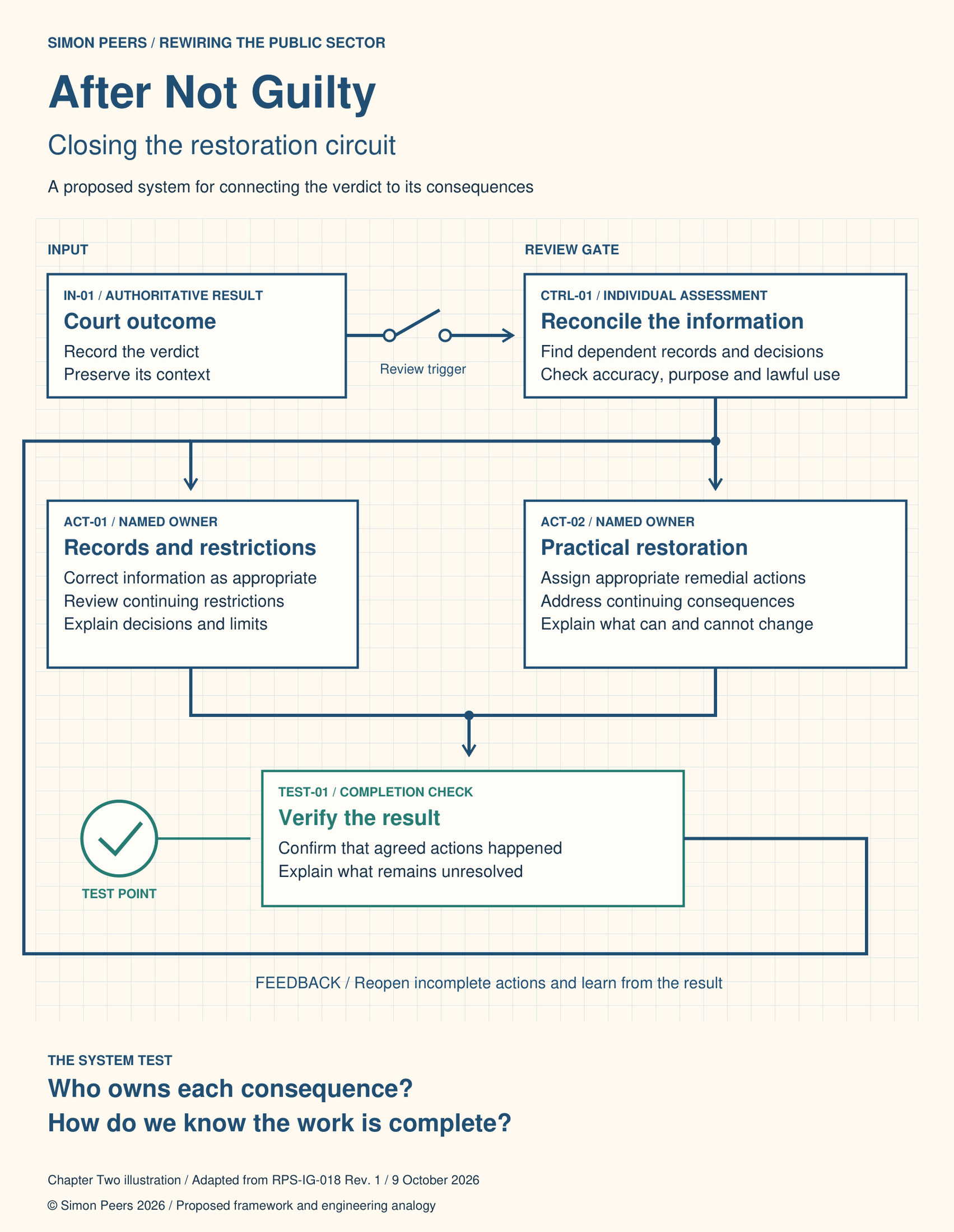
The test: Who owns each consequence? How do we know the work is complete?
WHAT SHOULD CHANGE?
Restoration requires action, not just acknowledgement.
A practical response might include checking relevant records, reviewing outstanding decisions, identifying the person responsible for each action, providing a clear explanation and verifying what has actually been completed.
There may be lawful limits, disputed issues and consequences that cannot be undone. A credible process should explain those honestly rather than suggesting that every problem has vanished.
The wider question
If every organisation has completed its own task, who checks whether the overall result has been put into effect? That is where the wider discussion of orphaned outcomes begins.
About this page: An introductory public-interest explanation adapted from the themes and approved artwork of Chapter Two, “Not Guilty — Then What?”, in Rewiring the Public Sector. It is not legal advice and does not allege misconduct by any named individual or organisation.

